
Schools Are Teaching AI Literacy. Who Is Teaching the Parents?
September 10, 2026 · Tyesha West
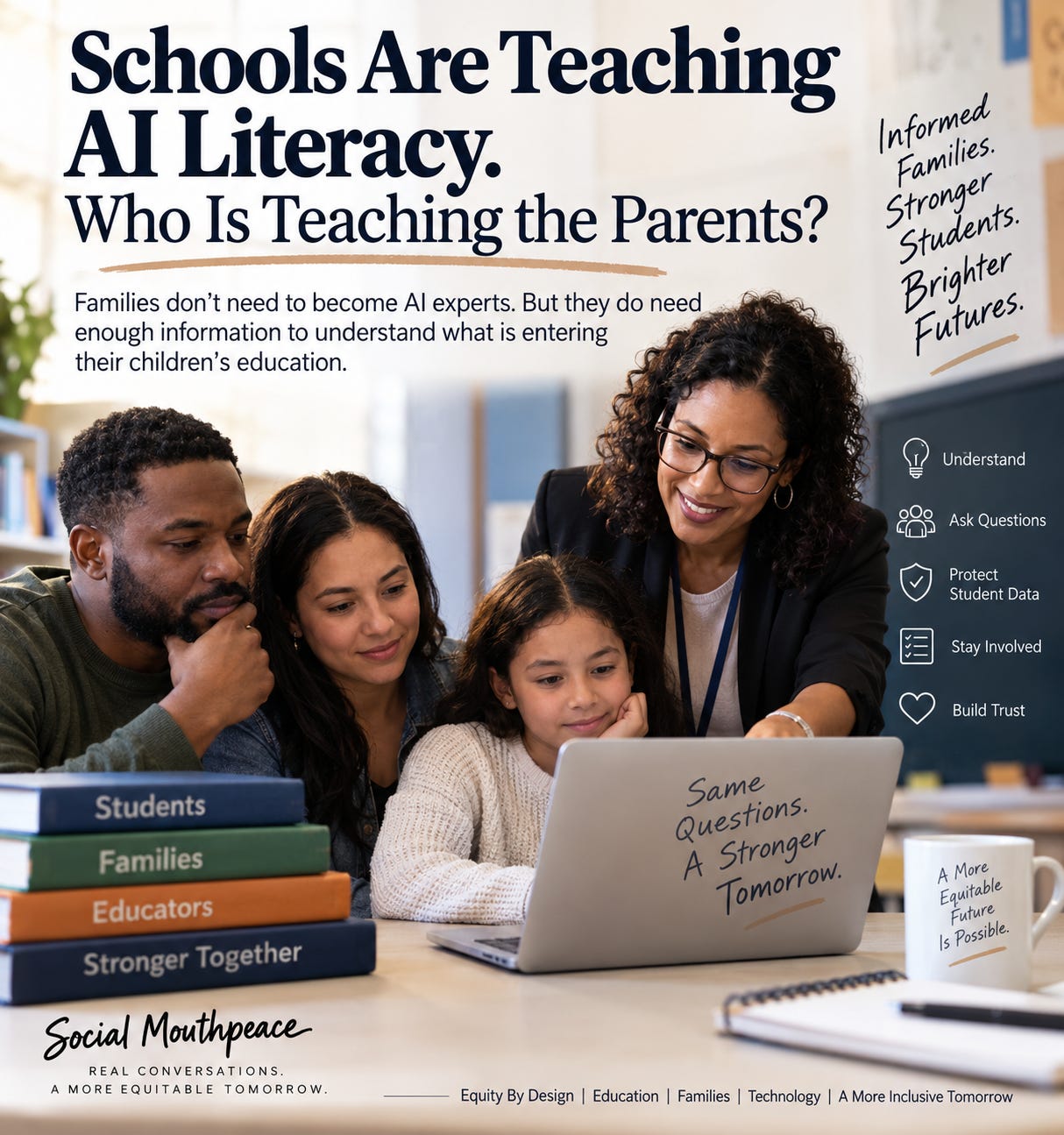
When I first started using AI, I thought it was a tool that could help me speed up and strengthen my thoughts.
If I needed a quick answer that was fully fleshed out and organized, it seemed better and faster than Google. It immediately had my attention.
Then I started learning what AI could actually do.
And understanding its capabilities was overwhelming. I remember thinking that I would probably always underutilize it because there was simply so much I didn’t know.
I use AI very differently now than I did when I first opened it.
But I had the opportunity to learn.
That’s the part I keep thinking about as both an educator and a parent.
If I received a letter from my son’s school saying he would begin using an “AI-powered learning platform” before I understood AI, I’m not sure that phrase would have meant much to me.
I probably would have thought, Okay. Here’s another app or tool the school is using to teach him something new.
But if I’m expected to support what happens after that letter comes home, shouldn’t I understand what I’m being told?
We can’t ask parents to make informed decisions about technology if they were never properly informed about the technology in the first place.
And if I never have an opportunity to understand the systems my child is using, how can I suddenly be held accountable for helping him navigate them?
What does AI literacy even mean for a parent?
I don’t think parents need a computer science course.
I don’t need a parent to explain a large language model to me before their child can use technology in school.
I do think they deserve some basic answers.
Where is my child encountering AI?
What is it doing?
What information about my child is being entered into it?
Can I control how much information about my child is entered?
What metrics is the system producing, and how do those metrics affect my child?
How is this helping my child grow?
How much is too much?
What happens when the AI is wrong?
Is my child being taught to use AI as a reference while still verifying information, or are we creating an environment where children learn to accept whatever a machine gives them?
And one of the biggest questions for me:
Are humans in control, or is the machine in control?
That question becomes even more important when technology begins touching grades, interventions, placement, recommendations or other decisions about a child.
The U.S. Department of Education’s August 2026 guidance on responsible education technology emphasizes evidence, educator judgment, transparency for parents and student outcomes. It also calls for greater transparency around how and when technology is being used, how tools are implemented and whether their use is actually contributing to meaningful learning.
That sounds reasonable.
But transparency only works if the person receiving the information understands what they’re being told.
Give me 15 minutes
If I had 15 minutes with a room full of parents before their children started using a new AI system, I wouldn’t begin with a policy.
I’d show them the technology.
This is what your child will be using.
This is why we’re using it.
This is what we believe it can do for your child.
This is why we selected this particular technology.
Then I would let them experience it.
Show them an assignment or task their child might encounter. Let them see where the AI enters the process. Show them what the child does, what the technology does and what the teacher sees.
If the system is supposed to help us identify growth, show families what that looks like too.
Then we talk about risk.
What can go wrong?
What information is being collected?
What protections has the school put in place?
What should families watch for at home?
Who do they contact when they have a concern?
I’m not suggesting every parent needs to leave knowing how to use every feature.
I’m suggesting they should leave knowing enough to ask questions.
Send isn’t the end of communication
I’ve received school communications as a parent that technically contained the information I needed but didn’t actually explain much of anything.
It is extremely frustrating.
Now the ownership is on me to dig deeper and find whatever information I’m missing or confused about.
I’ve experienced the same thing as an educator.
An internal message gets sent. The language is unclear or misleading. Everyone interprets it a little differently. Miscommunication follows.
Technology and privacy notices can be even worse.
Small writing. Technical language. Words that look really important.
And somehow I finish reading without knowing what any of it actually means for my child.
The assumption seems to be:
We sent it. You read it. You understand it. We’re moving forward.
But being notified and being informed are not the same thing.
Being notified means putting information in front of me. Being informed means making sure I understand what that information means and can actually use it to move forward.
So maybe we need to stop treating communication like an event.
Send the information.
Show me what it means.
Let me experience what my child will experience.
Give me a way to ask questions.
Then come back after implementation and tell me what you’re learning.
Send isn’t the end of communication.
It might only be the beginning.
Translating confusion still leaves you with confusion
This becomes even more important when we talk about multilingual families.
We often treat translation as though translation itself creates access.
It doesn’t.
A school can take a complicated AI policy and translate it perfectly into Spanish, Portuguese, Haitian Creole or another language.
The translation can be completely accurate.
And the parent can still be completely confused.
I think families need options.
Some people will read the letter.
Someone else may need an audio version where the information is slowly and clearly explained.
A visual learner might benefit from a short video that complements the letter and shows what the school is talking about.
Someone else may need a live conversation.
Why couldn’t we hold virtual community sessions where parents can ask questions and receive answers in real time? Why couldn’t some sessions be organized by language?
Why can’t a parent leave a voice message, send an email or schedule a video conversation with someone who can communicate with them in the language they understand best?
We already understand that children don’t all learn the same way.
Why would we assume their parents do?
When language becomes unreachable, trust becomes unattainable.
Parents can eventually lose faith in a school system because they get tired of feeling stuck and confused.
And too often we excuse that by saying the school’s job is to educate the student.
But why does educating the student require excluding the parent?
Who actually gets the opportunity to participate?
Schools say things like, Families were given an opportunity to participate.
Okay.
Who could actually take advantage of the opportunity?
A meeting in the middle of a workday might work beautifully for a parent who can take time off.
What about the parent working two or three jobs to keep their family together?
What about the person working overnight who needs to sleep during the day?
What about the family that lives far from school, doesn’t have a car and has public transportation that doesn’t align with all of their other responsibilities?
What about the caregiver who can’t attend another evening meeting because they’re taking care of children?
Those families aren’t necessarily disengaged.
The opportunity may have been designed in a way that excluded them.
And if our family-engagement system primarily hears from the people who already know how to navigate it, we’re going to keep hearing from the same people.
Maybe we need to pay more attention to the families who aren’t answering the survey.
The ones who stopped attending.
The ones who need interpretation.
The ones who never joined the PTO.
The ones who complained about the last technology rollout.
The ones we keep describing as “hard to reach.”
Maybe they aren’t hard to reach.
Maybe our way of reaching them doesn’t work.
Parents don’t need another job
There’s a danger here too.
I don’t want “family AI literacy” to become another way of transferring institutional responsibility onto families.
Schools employ educators, administrators, technology professionals and other specialists. Vendors are selling technology to institutions.
The answer cannot be:
Parents, educate yourselves about AI.
The school has a responsibility to understand the benefits and disadvantages of the technology it introduces.
It should understand how the technology is supposed to help students grow.
It should understand what safeguards are being put in place.
The vendor should be able to clearly explain what the product does, what information it collects, its limitations and the evidence supporting its claims.
Educators need enough training to understand the technology they’re being asked to use professionally.
And parents should receive enough information to understand what their children are experiencing and ask meaningful questions about it.
Family engagement shouldn’t mean transferring institutional responsibility onto families.
But I do think parents should have an opportunity to learn about the things their children are being taught.
Education changes with every generation.
Technology changes.
Information changes.
The world our children are preparing to enter isn’t exactly the world we entered.
If schools can help families understand some of those changes too, maybe we’re not only preparing one generation.
We’re helping close the knowledge gap between generations.
Don’t invite me after you’ve already bought it
This is where design WITH families becomes different from designing FOR them.
A familiar process looks something like this:
The school identifies a technology.
The technology gets selected.
A contract gets signed.
A policy gets written.
The policy gets translated.
Families get informed.
Then we say families were included.
Were they?
What if we identified the problem first?
Then brought together students, parents and caregivers, teachers, special educators, multilingual-family representatives, student-support staff, technology staff and administrators before deciding what the answer was?
What if we asked families:
What is difficult for your child right now?
What information do you wish you had?
What makes school technology difficult for your family?
How does your child learn best?
What concerns would you have about an AI tool?
What would you need to understand before you felt comfortable with your child using it?
Those questions aren’t asking families to choose software.
They’re asking families to help us understand the problem.
That’s different.
The U.S. Department of Education’s July 2025 guidance on AI use in schools specifically emphasizes engaging affected stakeholders, especially parents, in decisions about adopting and deploying new technologies. It also identifies AI literacy and educator professional development as areas for responsible AI integration.
If the product has already been purchased, the contract signed and the implementation plan written, asking families what they think isn’t really co-design.
We’re collecting reactions.
Design WITH has to happen early enough for what people tell us to actually change something.
The family is part of the whole child
As an educator, I want families to understand AI because this technology is going to affect the world their children inherit.
As a parent, I need schools to expand their definition of the whole child.
As the parent of a student, I am included in that whole.
If I understand something better, chances are I can better support my child in understanding it too.
And as the founder of Equity By Design, I don’t think AI literacy should simply teach people how to operate AI.
I think it should teach us how to question it.
How to ask better questions.
How to organize our thoughts.
How to examine what we’ve been given.
How to verify it.
How to challenge it.
And then how to decide what we’re going to do with it.
Ask. Question. Verify. Interpret. Challenge. Decide.
Those skills matter whether you’re a student, an educator or a parent.
Because access to AI isn’t enough.
If some people are only learning how to consume what AI gives them while others are learning how to interrogate it, verify it and use it strategically, we’ve created another divide.
We just gave it newer technology.
So yes, schools should prepare students for an AI-powered world.
But if we’re preparing children for a world their families were never taught how to navigate, I think we have another question to answer:
Who’s preparing their families?
